
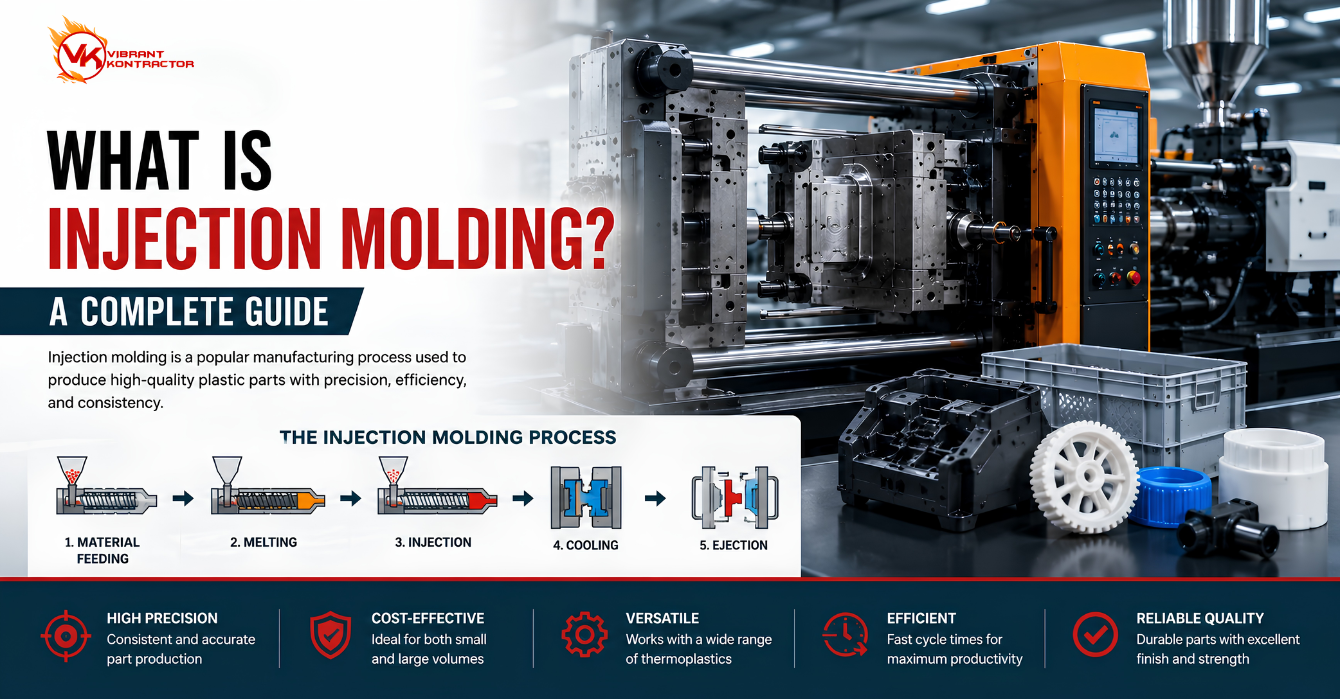
Injection molding is one of the most widely used manufacturing processes for producing high-quality plastic components with exceptional precision and consistency. From automotive parts and medical devices to consumer electronics, packaging, and household products, injection molding plays a critical role in modern manufacturing.
The process allows manufacturers to produce thousands or even millions of identical parts efficiently while maintaining strict quality standards. Due to its speed, repeatability, and cost-effectiveness, injection molding has become the preferred choice for businesses looking for large-scale plastic production.
In this comprehensive guide, you’ll learn how injection molding works, the materials used, the benefits it offers, common applications, design considerations, and why it remains one of the most reliable manufacturing methods across industries.
What Is Injection Molding?
Injection molding is a manufacturing process in which molten plastic material is injected under high pressure into a specially designed mold cavity. Once the material cools and solidifies, the mold opens and the finished part is ejected.
The process is highly automated, allowing manufacturers to produce complex plastic components with excellent dimensional accuracy and repeatability. Since the same mold can produce thousands of identical parts, injection molding is particularly suitable for high-volume production.
Whether manufacturing automotive clips, medical syringes, electrical housings, or food containers, injection molding delivers consistent quality while minimizing production waste.
How Does Injection Molding Work?
The injection molding process consists of several key stages.
1. Material Preparation
Plastic pellets are loaded into the hopper of the injection molding machine. These pellets are made from various thermoplastic or thermosetting polymers depending on the final application.
Common materials include:
- Polypropylene (PP)
- ABS
- Polyethylene (PE)
- Nylon (PA)
- Polycarbonate (PC)
- PVC
- Acetal (POM)
The choice of material depends on factors such as strength, flexibility, heat resistance, chemical resistance, and product functionality.
2. Melting the Plastic
The pellets move through a heated barrel where a rotating screw melts the plastic into a uniform molten material.
The rotating screw not only melts the material but also mixes it evenly before injection.
3. Injection Phase
The molten plastic is injected into the mold cavity at high pressure.
The mold is designed with extreme precision to ensure every detail of the product is accurately formed.
4. Cooling
Once inside the mold, the molten plastic begins cooling.
Cooling is one of the longest phases of the entire process because the part must solidify before removal.
Efficient cooling systems significantly improve production speed and product quality.
5. Ejection
After cooling, the mold opens and ejector pins remove the finished component.
The mold closes again, beginning another production cycle.
A complete cycle may take anywhere from a few seconds to several minutes depending on the product size and complexity.
Components of an Injection Molding Machine
An injection molding machine consists of three primary components.
Injection Unit
Responsible for melting and injecting the plastic into the mold.
Mold
The custom-designed tooling that determines the shape, size, and features of the final product.
Clamping Unit
Keeps the mold securely closed during injection while withstanding extremely high pressure.
Types of Injection Molding
Different manufacturing requirements demand different molding techniques.
Thermoplastic Injection Molding
The most common method where plastics can be melted and reused multiple times.
Applications include:
- Consumer goods
- Automotive parts
- Packaging
- Electronics
Insert Molding
Metal or other components are placed inside the mold before plastic is injected around them.
Common examples include electrical connectors and threaded inserts.
Overmolding
A second material is molded over an existing plastic or metal part.
This process improves grip, aesthetics, and durability.
Examples include:
- Toothbrush handles
- Power tool grips
- Medical instruments
Gas-Assisted Injection Molding
Nitrogen gas is injected into the molten plastic to create hollow sections while reducing material usage and product weight.
Materials Used in Injection Molding
Selecting the right material is essential for product performance.
Polypropylene (PP)
Lightweight, durable, and chemical-resistant.
Ideal for packaging and automotive applications.
ABS
Offers excellent impact resistance and surface finish.
Widely used in electronics and consumer products.
Polycarbonate
Known for exceptional strength and transparency.
Commonly used in medical devices and safety equipment.
Nylon
Provides excellent wear resistance and mechanical strength.
Used extensively in industrial machinery and automotive components.
Polyethylene
Flexible, moisture-resistant, and economical.
Suitable for containers, bottles, and household products.
Advantages of Injection Molding
High Production Efficiency
Injection molding can manufacture thousands of identical components with minimal variation.
Excellent Precision
Modern molds achieve tight tolerances and outstanding dimensional accuracy.
Cost-Effective for Large Production
Although mold manufacturing requires initial investment, the cost per part decreases significantly during mass production.
Minimal Material Waste
Unused plastic can often be recycled and reused, making the process more environmentally friendly.
Complex Product Designs
Injection molding allows manufacturers to produce intricate shapes that would be difficult using traditional machining methods.
Superior Surface Finish
Products often require little or no additional finishing after molding.
Consistent Product Quality
Automation ensures every component meets identical specifications.
Common Applications of Injection Molding
Injection molding is used across numerous industries.
Automotive Industry
Manufacturers produce:
- Dashboards
- Interior panels
- Clips
- Air vents
- Engine covers
- Lighting components
Medical Industry
Examples include:
- Syringes
- Surgical instruments
- Diagnostic equipment
- IV connectors
Consumer Electronics
Injection molding is used to manufacture:
- Mobile phone covers
- Laptop housings
- Remote controls
- Keyboard components
Packaging Industry
Products include:
- Food containers
- Bottle caps
- Cosmetic packaging
- Pharmaceutical containers
Household Products
Manufacturers produce:
- Storage boxes
- Kitchen utensils
- Furniture components
- Buckets
- Toys
Design Considerations
Successful injection molding depends heavily on product design.
Important factors include:
- Uniform wall thickness
- Proper draft angles
- Rib placement
- Gate location
- Cooling channels
- Material shrinkage
- Ventilation
Optimized designs reduce manufacturing defects while improving production efficiency.
Common Injection Molding Defects
Although highly reliable, certain defects may occur.
H3: Sink Marks
Caused by uneven cooling.
H3: Warping
Occurs when different sections cool at different rates.
H3: Short Shots
The mold cavity is not completely filled.
H3: Flash
Excess plastic escapes around mold edges.
H3: Burn Marks
Result from trapped air and excessive heat.
Proper mold design, machine settings, and quality control help eliminate these issues.
Injection Molding vs Other Manufacturing Processes
| Feature | Injection Molding | CNC Machining |
| Production Volume | High | Low to Medium |
| Material Waste | Very Low | Higher |
| Complex Shapes | Excellent | Moderate |
| Cost Per Part | Low (High Volume) | Higher |
| Repeatability | Excellent | Excellent |
Injection molding is generally the preferred choice for mass production, while CNC machining is more suitable for prototypes and low-volume manufacturing.
Factors Affecting Injection Molding Costs
Several factors influence overall production costs:
- Mold complexity
- Product size
- Material selection
- Production volume
- Machine size
- Cycle time
- Surface finishing requirements
Although tooling costs may appear high initially, large production runs significantly reduce the cost per unit.
Future of Injection Molding
Modern manufacturing continues to improve through technological advancements.
Current trends include:
- Smart manufacturing
- Industry 4.0 automation
- AI-driven quality inspection
- Robotic part handling
- Sustainable and recycled plastics
- Energy-efficient machinery
- Advanced simulation software for mold design
These innovations are making injection molding faster, more accurate, and environmentally responsible.
Conclusion
Injection molding has transformed modern manufacturing by enabling the efficient production of durable, high-quality plastic components at scale. Its combination of precision, speed, repeatability, and cost efficiency makes it one of the most valuable manufacturing processes across industries.
Whether you require automotive components, medical devices, industrial parts, consumer products, or custom plastic solutions, injection molding offers unmatched flexibility and reliability. By selecting the right materials, optimizing product design, and partnering with an experienced manufacturer, businesses can achieve superior product quality while reducing production costs and increasing operational efficiency.
Partner with Vibrant Contractor
At Vibrant Contractor, we provide precision Injection Molding, Mold Design & Manufacturing, and custom plastic component solutions tailored to your business needs. With advanced machinery, experienced engineers, and a commitment to quality, we help transform your concepts into high-performance products. Contact us today to discuss your project and discover how our manufacturing expertise can support your success.
Frequently Asked Questions
What is injection molding used for?
Injection molding is used to manufacture plastic products for automotive, medical, electronics, packaging, aerospace, and consumer industries.
Is injection molding expensive?
Tooling requires an initial investment, but the process becomes highly cost-effective for medium- and high-volume production.
Which plastic is best for injection molding?
The best material depends on the application. Polypropylene, ABS, Polycarbonate, Nylon, and Polyethylene are among the most commonly used materials.
Can injection molding produce complex parts?
Yes. Injection molding can create intricate designs with excellent dimensional accuracy and repeatability.
How long does an injection molding cycle take?
Cycle times typically range from 15 seconds to 2 minutes depending on part size, material, and mold design.